
Three supply numbers sit beside the same token. The smallest is not automatically wrong, and the largest is not automatically the number anyone can sell.
For readers checking crypto token supply, the missing detail is often what each field counts. Start with issued units, identify the exclusions once, and keep any unissued capacity separate. This is a reconciliation task, not a token ranking.
A contract counter is one record
The ERC-20 standard defines totalSupply() as a total-token-supply query. It also describes optional decimals() for converting amounts into a user-facing representation. It does not supply a standard circulating-supply query or a universal maximum-supply field.
For a named context, Circle's USDC registry lists Ethereum mainnet USDC at 0xA0b86991c6218b36c1d19D4a2e9Eb0cE3606eB48. That is a network-specific token identity, not a current supply reading.
Circle's repository README identifies an upgradeable design and a V2.2 implementation. In its base FiatTokenV1 source, totalSupply() returns the stored counter. The checked mint and burn paths add to or subtract from that counter; a minter's allowance is separately configurable.
Those functions do not classify holders into public, team or treasury allocations. A current minter allowance is also not a lifetime issuance cap. Our checked source does not establish a numerical permanent maximum for USDC; record that maximum as not established by these sources, rather than borrowing a number from another token.
This is a reference-code reading pinned to revision fc85788bc7c23cefe3df1a757133048bfddadeaa. We did not query the Ethereum contract, verify its current proxy implementation or measure a live supply. Keep code context, network and observation time together.
Circulation adds a classification method
CoinGecko's supply methodology calculates circulating supply by deducting identified uncirculated wallet balances from total supply. Its exclusions can include locked allocations and project or treasury holdings even when those holdings are technically unlocked.
That is a provider's classification, not a promise that every included token is on sale. A transfer restriction, a holder's identity and a data provider's treatment are different facts.
CoinMarketCap's definitions also distinguish circulating supply from unlocked supply. Its described review asks for allocation and wallet evidence; a self-reported field is not the same status as a provider-verified one.
An unavailable or unverified field is not evidence of zero. To reconcile two providers, first check their field definitions, covered networks, deductible wallets and timestamps. Do not average mismatched totals into a supposedly better supply number.
Reconcile a fictional allocation table
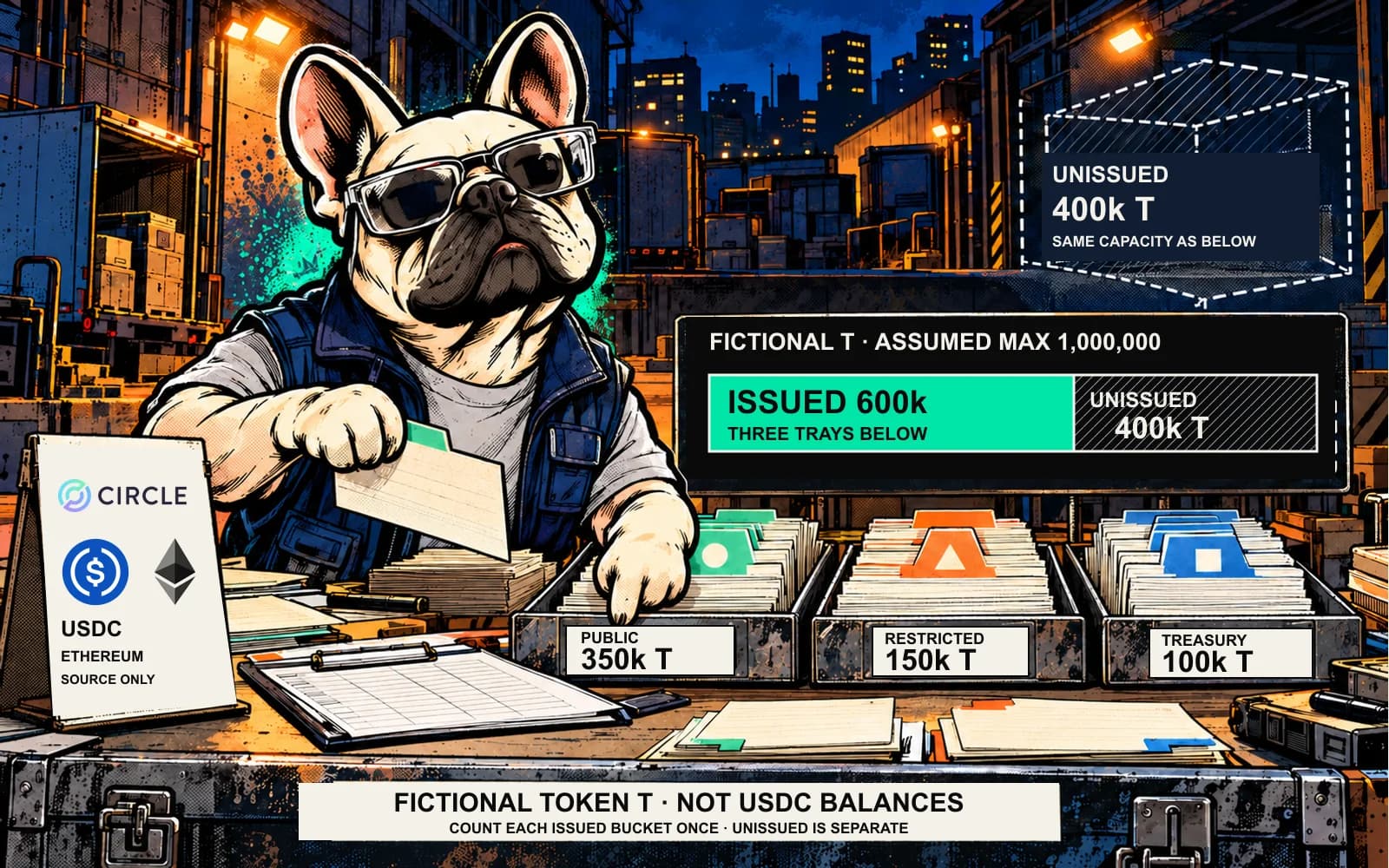
Invent token T with a 1,000,000 T issuance cap, 600,000 T already issued and no burns. Assume the following three issued buckets are complete, mutually exclusive and measured at the same time. For this example's circulation rule, include the public bucket and exclude both other issued buckets.
| Fictional bucket | Amount | Treatment in this example |
|---|---|---|
| Public holdings | 350,000 T | Already issued; included in circulation |
| Time-restricted allocation | 150,000 T | Already issued; excluded from circulation |
| Unlocked project treasury | 100,000 T | Already issued; excluded by the assumed rule |
| Remaining unissued capacity | 400,000 T | Outside the 600,000 issued total |
The issued ledger reconciles as 350,000 + 150,000 + 100,000 = 600,000 T. The circulation calculation is 600,000 − 150,000 − 100,000 = 350,000 T.
The separate capacity calculation is 1,000,000 − 600,000 = 400,000 T. Subtracting those 400,000 unissued units from the issued total again would mix two different starting points. They were never part of the 600,000.
These are invented allocations and assumptions, not a live supply, a real project's disclosed cap table or a statement about USDC holdings. There is no undisclosed real team or treasury quantity hidden in the example.
An unlock need not change all three fields
Now suppose 50,000 T from the restricted bucket becomes unrestricted but remains with an insider excluded by the example's circulation rule. Merely removing the time restriction does not force our circulating figure to change. Total issued remains 600,000 T, and the assumed cap remains 1,000,000 T.
Consider a different, explicitly assumed outcome: those 50,000 T enter public holdings and qualify under the rule. Public holdings become 400,000 T, while the remaining excluded buckets sum to 200,000 T. Then 400,000 + 200,000 = 600,000 T still reconciles.
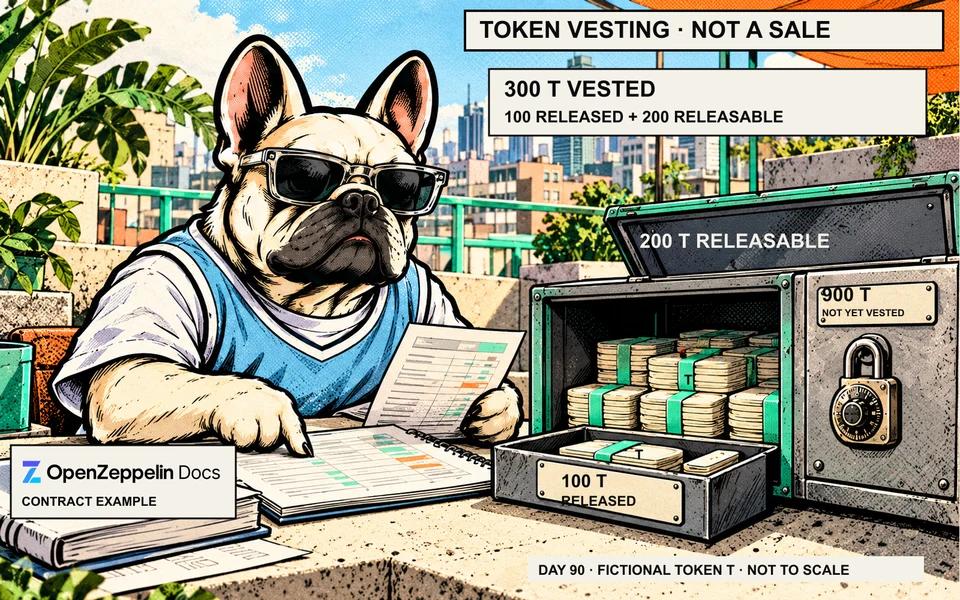
That is not a new mint, a proven sale or an automatic provider update. Our vesting explainer separately follows vested, releasable and released amounts. The classification here is an additional assumption, not a result obtained from a calendar.
The denominator changes a valuation label
Return to the initial 350,000-circulating snapshot and assume an invented price of $2 per T. Keep that same price across all three calculations:
| Supply basis | Fictional units used | Price multiplied by that basis |
|---|---|---|
| Circulating | 350,000 T | $700,000 |
| Total issued | 600,000 T | $1,200,000 |
| Assumed maximum | 1,000,000 T | $2,000,000 |
CoinMarketCap's cited page labels total-supply-times-price as minted market cap and maximum-supply-times-price as fully diluted valuation. Read a provider's actual definition before mapping its labels onto another site's fields.
The two larger numbers differ here because total and maximum differ. If a maximum is unknown, a maximum-based calculation is not available from these inputs; replacing it with total silently changes the question.
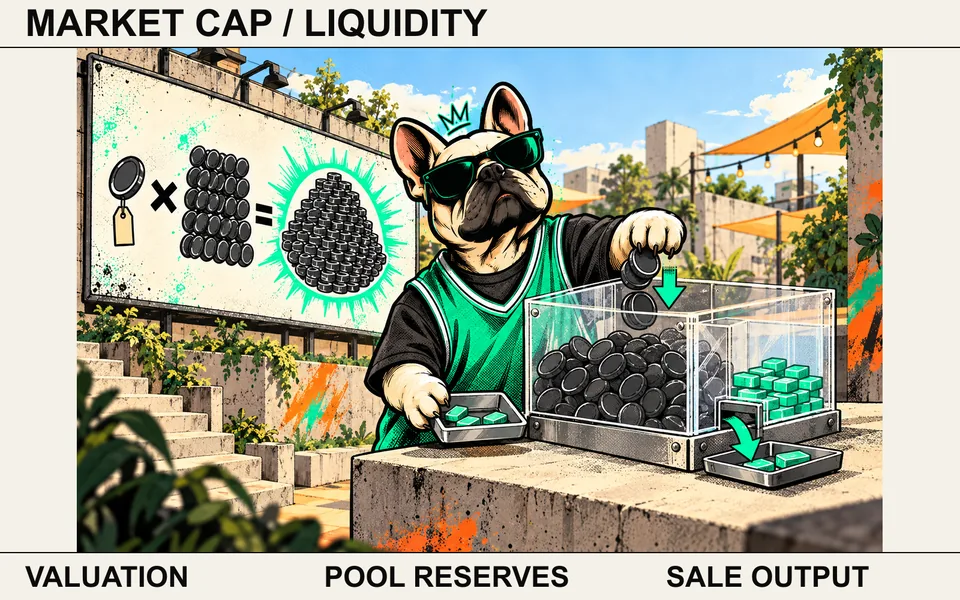
None of these products adds buyers or measures proceeds. Our market-cap versus liquidity explainer covers execution depth. The table here isolates supply assumptions, without a quote, price forecast, dilution prediction or investment conclusion.
Network scope and burn adjustments can duplicate units
CoinGecko's supply-update FAQ distinguishes native issuance on multiple chains from lock-and-mint and burn-and-mint bridge arrangements. It also explains why tracked wrapped representations are excluded from its global market-cap total to prevent duplication.
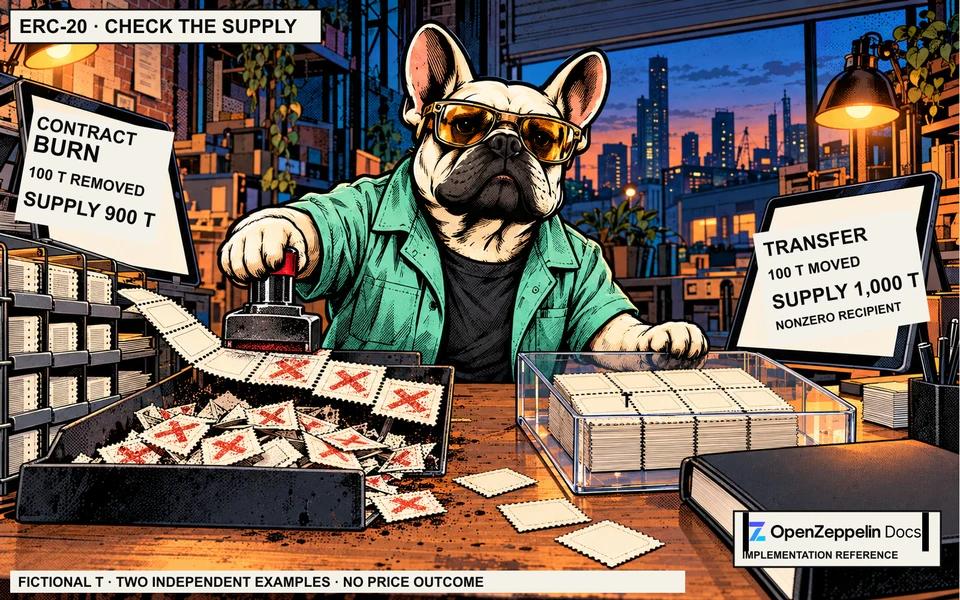
Do not simply add every token bearing the same symbol across chains. Identify whether a balance represents new native issuance or an existing asset held elsewhere. Nor should a burn already reflected in the starting supply counter be deducted a second time. Our burn explainer separates counter reductions from transfers to labelled addresses.
A useful supply record includes the exact asset and network coverage, units, observed time or block where available, starting total, named exclusions, treatment of bridges and evidence for any maximum. The token-identity guide provides the first step. Keep unknown values explicit instead of filling them with plausible numbers.
Sources
Primary specification, Circle reference code and current provider methodologies checked October 28, 2026, Asia/Tbilisi. Provider classifications are their methods, not our verification of any project's allocations. Circle code is pinned to the revision above; no live proxy, RPC, wallet, issuance, burn, holder balance or market quote was tested. All token T quantities, the assumed cap, the allocation change, the price and the illustration are fictional. The example is not a current USDC supply report or a claim of a fixed USDC maximum.
- ERC-20 specification: supply and unit representation.
- Circle Docs: USDC mainnet and testnet contract registry.
- Circle EVM repository: pinned README and implementation context.
- Circle EVM source: total supply, mint, burn and minter allowance.
- CoinGecko: supply methodology and uncirculated-wallet classifications.
- CoinGecko: supply-update FAQ and multichain treatment.
- CoinMarketCap: circulating, total, maximum and valuation definitions.
See something wrong? Brokzi logs material changes. Prepare a correction note.