A liquidity position can still hold tokens while its swap-fee earnings stop. In Uniswap v3, the missing detail may be the price range: a position supplies active liquidity only where that range covers the pool's current price.
For readers interpreting an LP screen, separate three things: the selected boundaries, the tokens behind the position and fees already earned. We will follow one fictional range through three prices. Nothing below selects a range for you or describes a live investment.
A concentrated liquidity range belongs to the position
Uniswap's concentrated-liquidity guide describes liquidity assigned to a bounded price interval. Several positions in the same pool can have different boundaries.
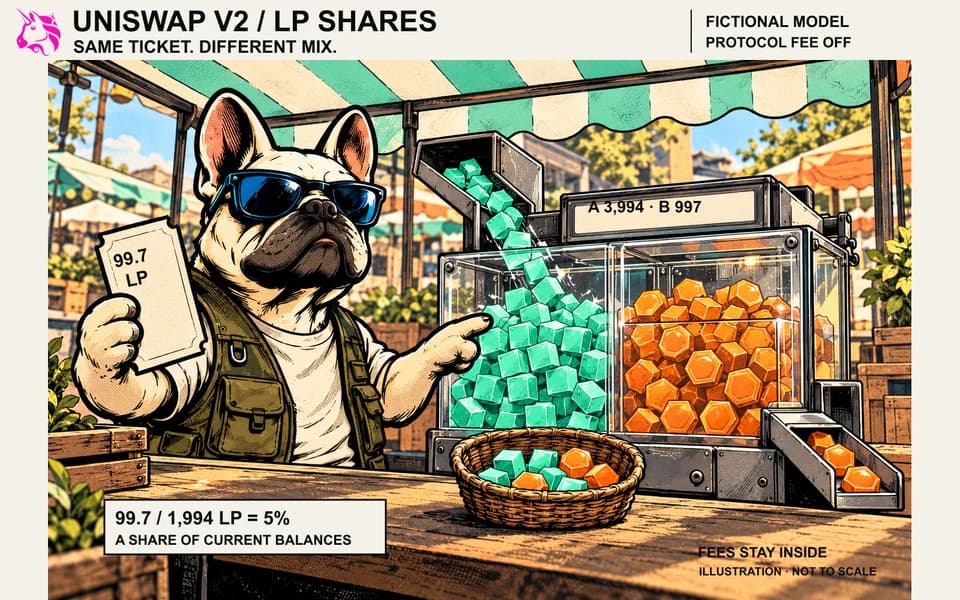
Consequently, the pool can keep trading while one particular position is out of range. Total pool value alone cannot tell you whether that position participated in a swap. Our v2 LP-share explainer follows a different ownership model; its simple fraction of pool balances is not a calculator for a v3 range.
Keep price orientation explicit. A price of 200 Q per B means one unit of B is priced in Q. Reversing the displayed pair reverses the ratio. A number without its units can make the same position look as though it crossed the opposite boundary.
Follow one fictional position below, inside and above its range
Use invented tokens B and Q, with P measured in Q per B. B is the base asset, corresponding to token0; Q is the quote asset, corresponding to token1. Neither is a real token or a dollar peg.
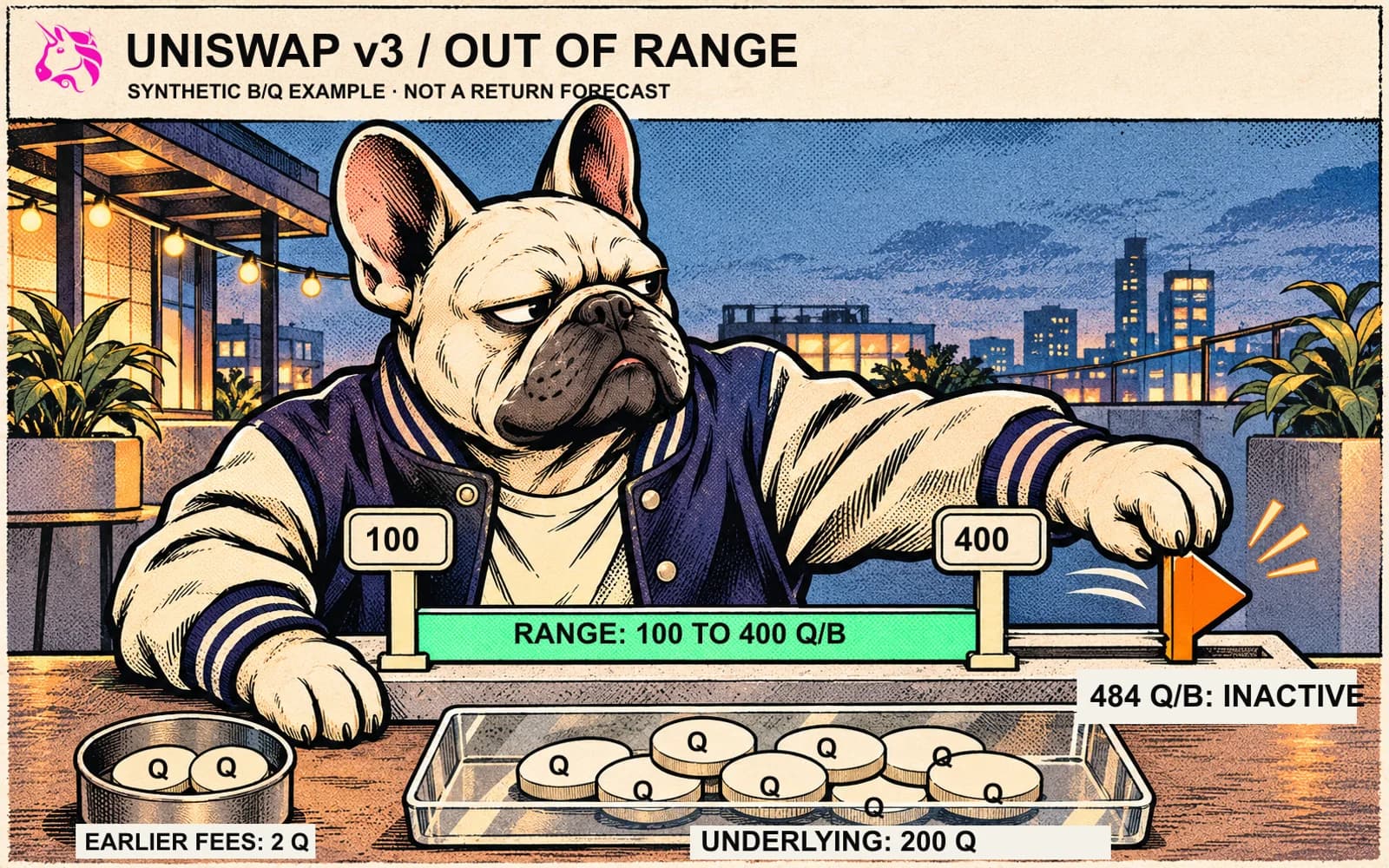
Our teaching interval runs from 100 to 400 Q per B. Set the position's liquidity coefficient, L, to 20 in consistent normalized units. This is an idealized continuous-price illustration of the v3 whitepaper's reserve relationships, not executable position parameters. Real v3 positions use eligible ticks, token-unit scaling and integer rounding, which this calculation leaves out.
Exclude accrued fees, incentives, costs and any changes to the position's L. The underlying quantities follow the range-limited reserve model. Inside the range, with x measured in B and y in Q:
x = L × (1 / √P − 1 / √400)
y = L × (√P − √100)
The square roots of our boundaries are 10 and 20. At 225 Q per B, √P is 15:
x = 20 × (1/15 − 1/20) = 1/3 B
y = 20 × (15 − 10) = 100 Q
Below the lower bound, the B quantity reaches 20 × (1/10 − 1/20) = 1 B, and the Q quantity is zero. Above the upper bound, the B quantity is zero and the Q quantity reaches 20 × (20 − 10) = 200 Q.
| Pool price (Q/B) | Range status | B principal | Q principal | New swap fees |
|---|---|---|---|---|
| 81 | Strictly below | 1 B | 0 Q | Inactive |
| 225 | Strictly inside | 1/3 B | 100 Q | Active while the swap uses this range |
| 484 | Strictly above | 0 B | 200 Q | Inactive |
These are alternative states of the same unchanged position, not three baskets owned simultaneously. We deliberately avoid prices exactly on a boundary. The contract's tick accounting determines those edge cases.
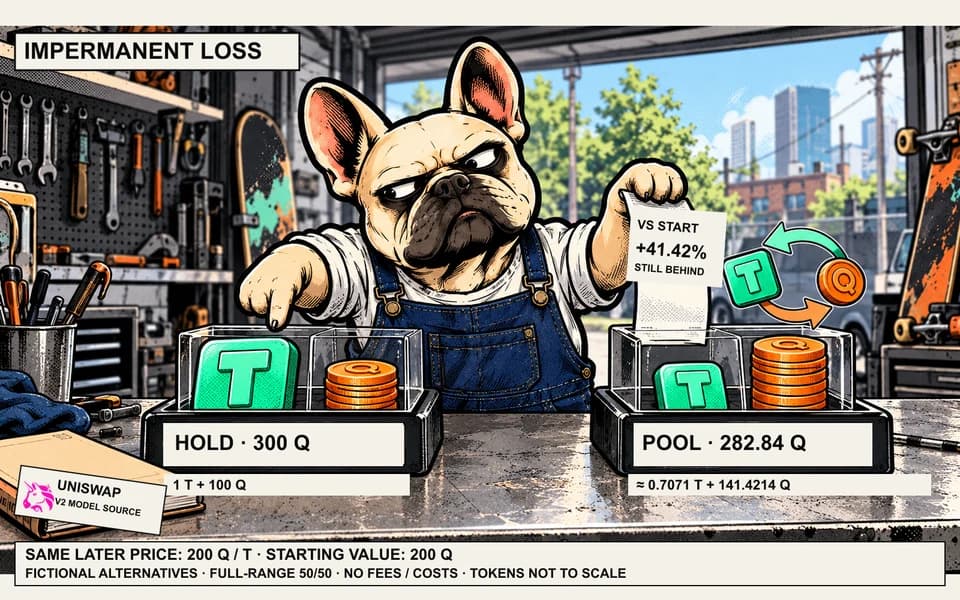
At 484, there is still a 200-Q underlying position. It has not become an empty account merely because the screen says out of range. Equally, 200 Q does not establish a profit: we have not supplied a starting-cost or holding benchmark. Our impermanent-loss guide handles that separate comparison.
Active liquidity determines participation, not a promised payment
The fee guide allocates LP fees to liquidity active during the relevant swap, in proportion to that active liquidity. Being inside the range is a participation condition; it does not create trading volume or a fixed income stream.
For a separate fictional fee-allocation exercise, suppose the position contributes 20 units of active L out of 100 throughout one calculation interval. Assume 10 Q is the fee amount distributable to LPs for that interval, already after any protocol deduction. The position's share is:
20 / 100 × 10 Q = 2 Q
That denominator is active liquidity, not all tokens deposited anywhere in the pool. The example assumes a constant set of active positions during the interval. A swap crossing boundaries needs the protocol's interval-by-interval accounting; one percentage should not be stretched across the whole route.
If our position is inactive throughout a different swap, it does not earn a new LP swap-fee allocation from that swap. A reward program or wrapper may have other rules, which this v3 pool example does not evaluate.
Leaving the range does not erase previously accrued fees
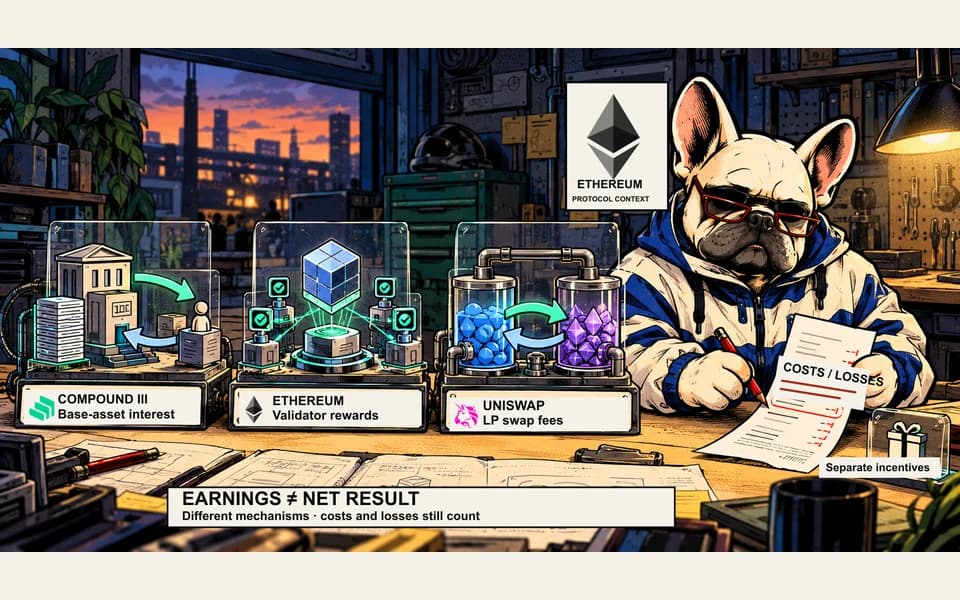
Uniswap's current fee documentation distinguishes v3's separately claimable position fees from v2's reserve-based compounding. A position's underlying token mix and its uncollected fees therefore need separate lines.
Suppose our teaching position had previously accrued 2 Q. At the above-range state, record 200 Q underlying plus 2 Q previously accrued, before costs. Do not describe that as 202 Q newly earned, or add those same 2 Q again if a screen's combined value already includes them.
An out-of-range label does not independently prove the accrued balance, ownership or successful collection. Those require the position's actual records. No fee claim or withdrawal was performed for this article.
What happens if the price returns?
The concentrated-liquidity guide says an unchanged position becomes active again when price reenters its range. That describes a conditional mechanism, not a forecast that reentry will occur or recover losses.
In our idealized example, a return from 484 to 225 Q per B gives the same underlying 1/3 B and 100 Q, provided L and the boundaries remain unchanged. Separately accrued fees still need their own accounting. A vault that moves or reinvests a position changes those assumptions.
Nor is a narrow range a free improvement. To read a position rather than its advertised percentage, keep a short record:
- Network, exact pool, protocol version and token order, with consistent token decimals.
- Lower and upper ticks, the displayed price orientation and the observation time.
- Position liquidity and whether it was active for the swaps being measured.
- Underlying token quantities, accrued fees, collected fees and costs, counting each once.
- Any wrapper or reward-program rules, identified separately from the underlying pool.
Brokzi's Take
Start with the range and units before interpreting an earnings line. A position can remain funded while inactive; previously earned fees and new fee participation answer different questions. The worked B/Q states make that distinction visible without a wallet connection, deposit or yield estimate.
Sources
Primary material checked November 3, 2026. This article covers Uniswap v3 mechanics, not a new protocol launch or a claim about every v4 hook. The linked whitepaper dates to March 2021; its historical initial fee settings are not treated as current pool configuration. Synthetic calculations use exact fractions and omit tick-grid selection, token-unit scaling, rounding and costs. No live position, pool fee setting, APR, swap, RPC query or transaction was tested. The cover is a fictional visual explanation, not an official interface or endorsement.
- Uniswap: Concentrated liquidity: chosen ranges, active liquidity, single-asset exposure and reentry.
- Uniswap v3: Protocol overview: version boundary and linked primary protocol material.
- Uniswap: Fees: active-liquidity allocation, separate position fees and protocol deductions.
- Uniswap v3 Core whitepaper, March 2021: sections 2, 3.2, 6.1 and 6.4; reserve relationships and position accounting underlying the fictional calculation.
See something wrong? Brokzi logs material changes. Prepare a correction note.