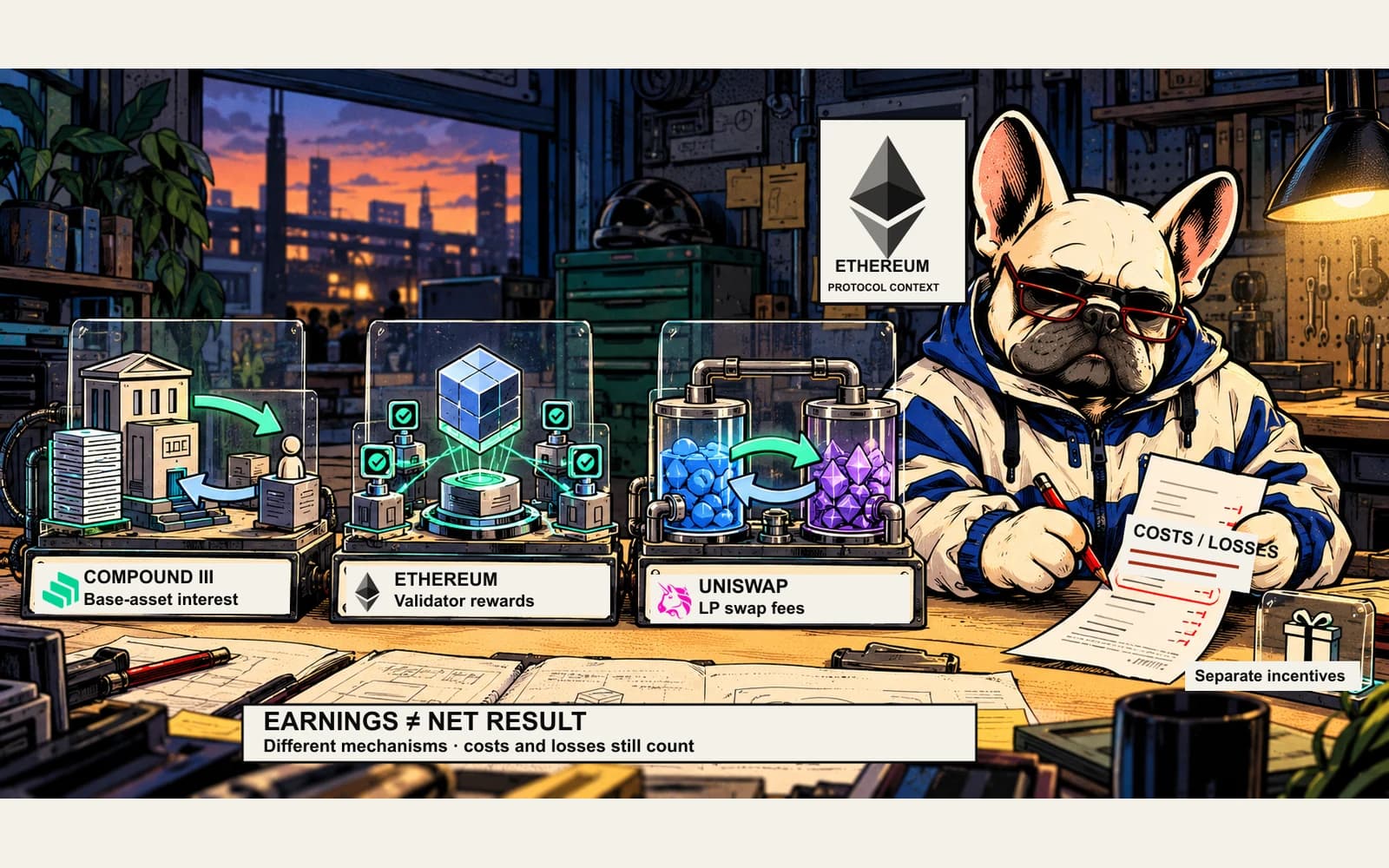
Three screens say "earn." One position lends an asset, another supports Ethereum validators, and the third makes tokens available for swaps. The headline percentages hide different activities and different ways to lose money.
For readers comparing DeFi lending vs staking, start with the source of compensation before comparing a rate. Liquidity-provider fees, often grouped into the same discussion, need a third column. This is a map of the mechanisms and a worksheet for reading their accounting, not a ranking of products or current returns.
Ask what activity creates the payment
| Named context | Activity behind the compensation | Accounting to inspect | A distinct limit |
|---|---|---|---|
| Compound III base-asset supply | Borrowing and lending, with separate supply and borrow rate models | Interest in the base asset; any incentive tokens separately | A positive supply claim is not cash immediately available to withdraw |
| Ethereum validator staking | Consensus duties, with applicable rewards and proposer fees | ETH rewards, penalties and any operator charges | Validator participation can incur losses; a pooled product adds its own terms |
| Uniswap liquidity provision | Traders pay swap fees to use pool liquidity | Position assets, fees and applicable protocol deductions | Earning fees does not guarantee outperforming the original tokens held |
The same word on a dashboard does not turn those activities into the same claim. A service can also combine them: a token representing staked assets may later be lent or deposited into a pool. That adds dependencies rather than merging the underlying mechanisms.
Lending interest needs the right side of the balance sheet
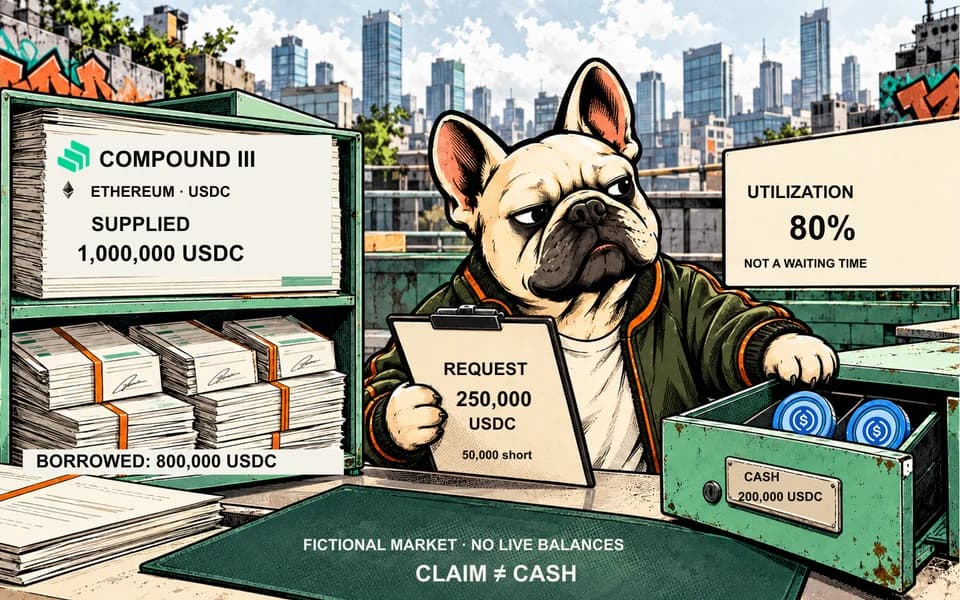
Compound III's introduction distinguishes supplying the base asset from supplying other collateral. Its interest-rate documentation says a positive base-asset balance earns interest in that asset, while a negative balance pays interest. Collateral assets do not earn that supply interest.
Supply and borrow rates use separate governance-set models linked to utilization. The borrower's displayed rate is therefore not automatically the supplier's return. The collateral-and-borrowing reference also distinguishes adding collateral, repaying debt and increasing a positive supply balance. One button labelled Supply can serve different accounting roles.
Keep incentive programs in another line. Compound's protocol-rewards documentation describes reward tracking and claim conditions separately from base-asset interest. A reward token's quantity, eligibility and market value are additional inputs, not more units of the supplied asset.
Interest accrual does not certify immediate access to tokens, repayment or contract safety. Our utilization and available-liquidity explainer follows those withdrawal constraints without turning a rate into a payment deadline.
Ethereum staking pays for a different role
Ethereum's staking overview describes ETH committed to validators participating in consensus. The protocol rewards validator duties; block-proposal activity can also receive the unburnt portion of transaction fees. There need not be a loan to a borrower behind that staking reward.
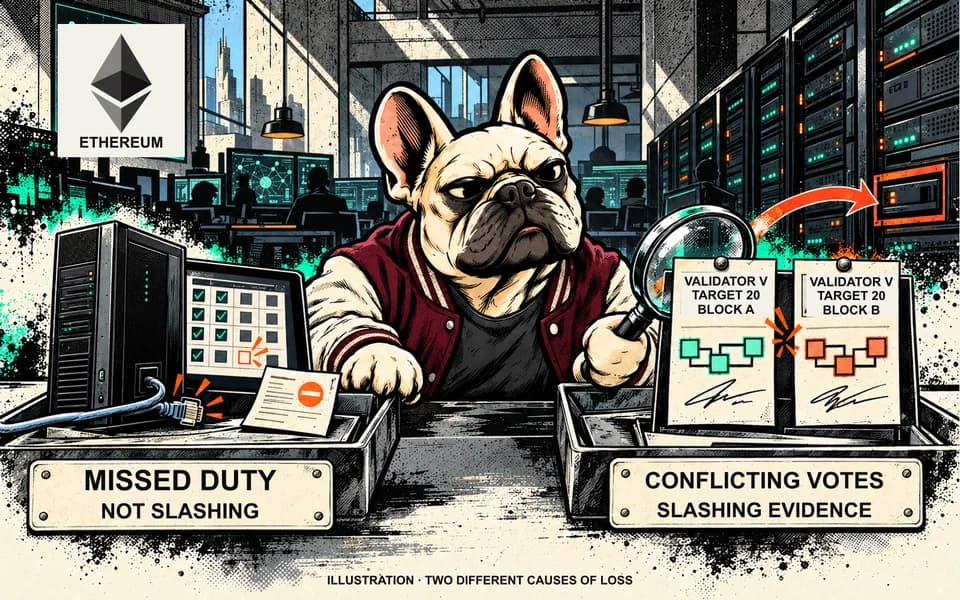
The rewards-and-penalties documentation describes rewards for duties such as attestations and proposals, alongside penalties and slashing. Its overview mixes historical and later examples, so no numeric penalty, exit duration or current APR is adopted here.
A pooled or hosted staking route puts additional software, operators or custody arrangements between the holder and Ethereum. Read its actual fee and reward-distribution rules. A provider's display is not automatically the raw validator result. Our staking-loss guide separates missed rewards, ordinary penalties and conflicting-signature slashing.
Receiving ETH rewards also does not fix ETH's value in another currency. A liquid token adds another accounting and exit layer; the liquid-staking explainer keeps wrapper conversion, sale and protocol withdrawal separate.
LP fees compensate liquidity used by traders
An LP, or liquidity provider, supplies assets to a pool against which swaps execute. Uniswap's fee guide distinguishes swap fees, protocol fees and version-specific treatment. The entire fee paid by a trader should not automatically be described as the holder's income.
In the documented v2 model, swap fees enter pool reserves. A valuation of the resulting position already includes their reserve contribution; adding the same fees again inflates the result. In v3 and v4, position fees are separately claimable. The current guide describes enabled protocol fees, so a simplified fee-off example elsewhere is not a live claim about the share LPs receive.
Uniswap v2's pool guide describes a share of current pool assets. Concentrated-liquidity documentation describes a different range-position model: liquidity outside its active range stops earning swap fees. Keep the version and range with the fee report.
Swaps also change the assets behind the position. Fee income can coexist with a shortfall against holding the original basket. Our LP-share guide owns the reserve accounting; impermanent loss owns that holding comparison. Neither is a promise that fees cover losses.
A positive earnings line can accompany a negative result
Use one fictional report over an unspecified observation period. Q is an invented unit of account, not dollars or a redeemable stablecoin. Assume no deposits or withdrawals during the period and mutually exclusive accounting components:
| Fictional report component | Value in Q |
|---|---|
| Opening position value | 1,000 |
| Separately accounted operating compensation | +8 |
| Incentive: 2 R at an assumed 2 Q per R | +4 |
| Costs, counted once | −3 |
| Other position-value change, excluding the compensation above | −15 |
| Reconciled ending value | 994 |
The two positive components total 12 Q. The result is 1,000 + 8 + (2 × 2) − 3 − 15 = 994 Q, a 6-Q decline from the opening value. The earnings line can be positive while the complete marked result is negative.
This is generic bookkeeping, not a result for Compound, Ethereum or Uniswap. The 8 Q is assumed compensation, not a protocol rate; the −15 Q is an assumed valuation adjustment, not a calculated slashing or impermanent-loss penalty. No annualization or return forecast follows from it.
For a real report, first establish which components are already included in the ending position. If its value already contains the 8 Q, do not add that compensation a second time. Use consistent end-of-period valuation inputs for separately held rewards and disclose any missing or unavailable price. A marked value is also not a guaranteed exit quote.
Read the claim before comparing the percentage
Keep the network, protocol version, exact asset and holding period with the report. Identify the underlying activity, who pays or allocates the compensation, the distribution rules and what receipt or token you hold. Separate operating compensation, incentive tokens, costs and asset-price changes; leave missing quantities unresolved.
Then check the exit: available liquidity, protocol withdrawal rules and any service conditions. A token can be transferable while a particular exit remains constrained. An APR or APY label alone cannot answer those questions or make lending, validator staking and LP exposure interchangeable.
Sources
Primary documentation checked October 29, 2026, Asia/Tbilisi. Named protocols illustrate documented mechanisms, not recommended products, observed balances, current rates or geographic availability. The Q/R ledger and artwork are fictional. No deposit, staking operation, trade, approval, reward claim, RPC query or deployed-contract audit was performed. Historical overview examples and live yield figures are excluded; current configurations and any individual payout remain unverified.
- Compound III: Introduction — base-asset supply versus collateral.
- Compound III: Interest rates — separate supply and borrow models, base-asset interest and collateral exclusion.
- Compound III: Collateral and borrowing — signed balances and distinct supply actions.
- Compound III: Protocol rewards — separate incentive tracking and claims.
- Ethereum.org: Staking — consensus role, rewards, fees and additional provider layers.
- Ethereum.org: Rewards and penalties — qualitative duty and loss categories only.
- Uniswap: Fees — swap/protocol distinction and version-specific accounting.
- Uniswap v2: Pools — pool-specific asset shares.
- Uniswap: Concentrated liquidity — active ranges and fee-accrual boundary.
See something wrong? Brokzi logs material changes. Prepare a correction note.