
You supplied two tokens to a liquidity pool. Later, the number of LP tokens in your wallet looks unchanged, but the underlying token amounts are different. Nothing had to be taken from a personal storage box: the position was a share of a trading pool, not a bag set aside in your name.
For readers interpreting that position, three numbers need separating: your LP-token balance, total LP-token supply, and the pool's current balances. This explainer follows Uniswap v2's canonical core code at v1.0.1. It is not a universal calculator for every pool or protocol version.
What an LP token records in Uniswap v2
Uniswap's v2 pool documentation describes liquidity tokens minted when liquidity is added and burned when the underlying assets are removed. These are pool-specific accounting tokens, not the UNI governance token. The v2 token implementation records balances and total supply separately.
In an ordinary synchronized state, the useful starting calculation is:
Your fraction = your LP tokens / total LP tokens
Multiply that fraction by each current pool balance to estimate the underlying quantities. In the actual pair contract's burn function, pending protocol-fee minting happens first, and outputs use token balances and the resulting total supply, with integer rounding. A screen's earlier percentage is therefore not a guaranteed withdrawal quote.
LP tokens can also be transferred. Their current holder is not necessarily the person who made the original deposit. A staking contract or vault holding them introduces another ownership layer; its receipt needs its own accounting.
Another deposit can lower your percentage without shrinking your claim
Use fictional tokens A and B, each with 18 decimals. An established teaching pool holds 997 A and 997 B, with 997 LP tokens in total. You hold 99.7 LP, or 10%, corresponding to 99.7 A and 99.7 B.
Assume ordinary transfers, balances matching reserves, no donations or rebases, and the protocol fee switched off. That last setting is deliberately hypothetical, not a claim about a live Uniswap pool. Ignore transaction costs and external prices. The existing total supply includes v2's permanently locked minimum liquidity; this is not a fresh deposit giving one person every redeemable LP token.
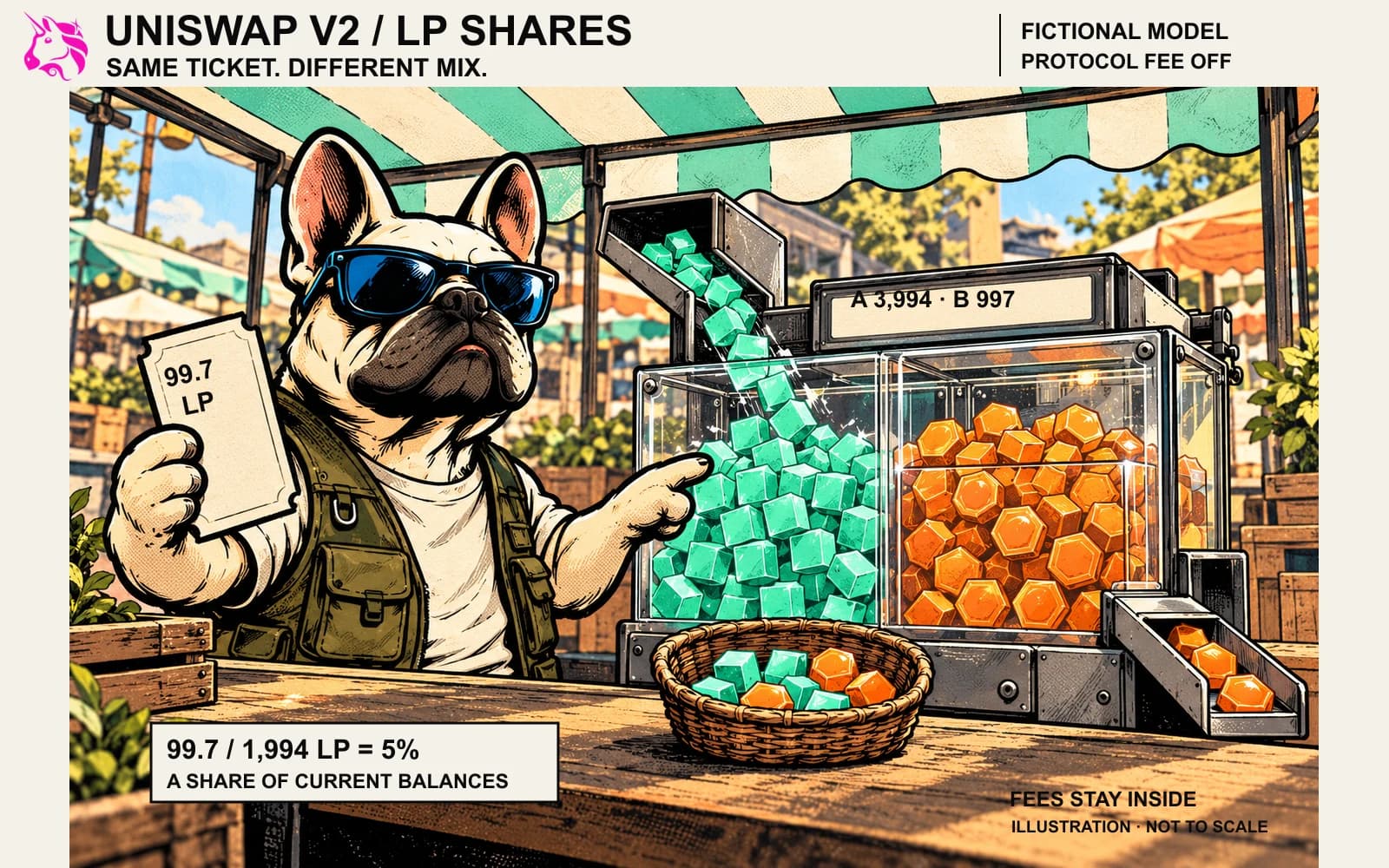
Another provider adds 997 A and 997 B at the same ratio. The pair's mint calculation issues 997 new LP tokens. Total supply becomes 1,994 LP, while your balance stays 99.7 LP.
Your fraction is now 99.7 / 1,994 = 5%. But the pool has doubled to 1,994 A and 1,994 B, so your underlying quantities are still 99.7 A and 99.7 B. A smaller percentage of a larger pool is not, by itself, a loss of your existing token claim.
The older v2 returns page says percentage shares remain the same when others add or withdraw. That wording is misleading if read literally. The mint code increases total supply; the example above follows that denominator rather than assuming the old percentage is preserved.
A swap changes what sits behind the same LP balance
Next, keep total LP supply unchanged and let a fictional trader send 2,000 A into this enlarged pool. The v2 swap fee is 0.30%, or 6 A. For this ordinary one-direction swap, the fee-adjusted input is 1,994 A.
The fee-adjusted constant-product calculation gives:
B out = (1,994 A × 1,994 B) / (1,994 A + 1,994 A) = 997 B
The pool receives the full 2,000 A, not just the adjusted amount. Its resulting balances are 3,994 A and 997 B. The 6 A fee remains inside the pool. Our unchanged 99.7 LP now represents 5% of those balances:
| Fictional state, before your withdrawal | Pool balances | Total LP supply | Your LP balance | Your fraction | Your underlying quantities |
|---|---|---|---|---|---|
| Starting state | 997 A + 997 B | 997 LP | 99.7 LP | 10% | 99.7 A + 99.7 B |
| Another provider adds liquidity | 1,994 A + 1,994 B | 1,994 LP | 99.7 LP | 5% | 99.7 A + 99.7 B |
| Trader swaps A for B | 3,994 A + 997 B | 1,994 LP | 99.7 LP | 5% | 199.7 A + 49.85 B |
Burning your 99.7 LP at that last state, under these assumptions, returns 199.7 A and 49.85 B. The remaining pool has 3,794.3 A, 947.15 B and 1,894.3 LP. The withdrawal removes both underlying tokens; it is not itself a swap of everything into A.
The deliberately large trade makes the arithmetic exact and easy to check. It is not a typical quote or a suggested transaction. We have assigned neither token a dollar value, so adding their quantities cannot produce a meaningful profit figure. Price impact and slippage concern the separate execution question.
Fees are already inside that v2 result
Do not add a second fee bonus to the table's withdrawal amounts. In this fee-off teaching case, swap fees are already part of the balances being divided. The raw reserve product grows from 1,994 × 1,994 = 3,976,036 to 3,994 × 997 = 3,982,018, measured in A-times-B units. It is the fee-adjusted swap invariant that the contract checks, not an assertion that the raw product never changes.
Current Uniswap fee documentation describes protocol fees as active on v2 pools. Do not turn our hypothetical fee-off setting into a claim that LPs currently keep the entire 0.30% everywhere. In the selected pair code, an enabled protocol fee can mint additional LP tokens to feeTo on a liquidity event, increasing the denominator before withdrawal amounts are calculated. The main table excludes that mint; it is not a fee-on payout quote.
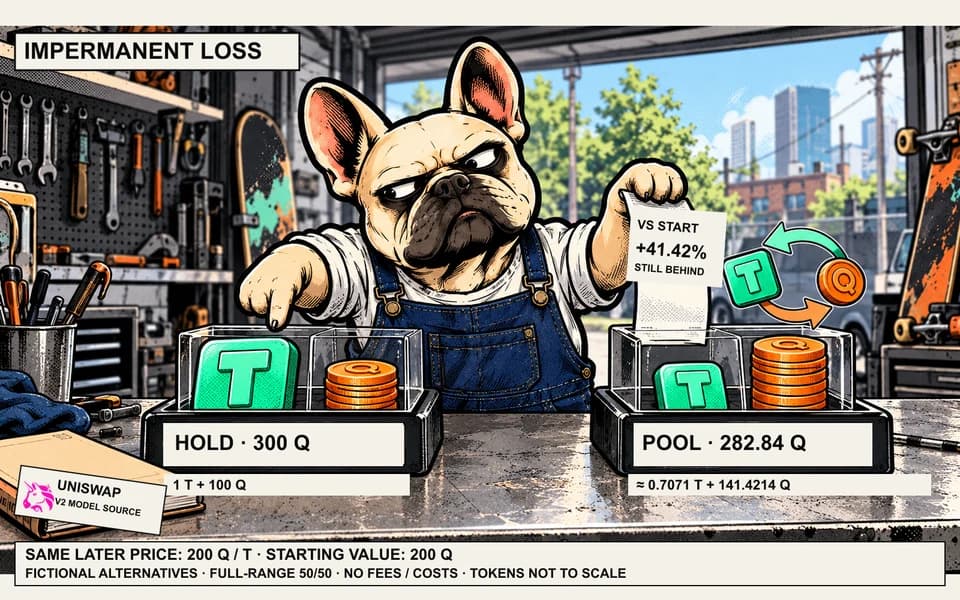
Fee income is not guaranteed to offset changing token exposure, costs or losses. The comparison with holding the original basket belongs in our separate impermanent-loss explainer, not in a percentage of LP-token supply.
Why v3 and v4 positions need different inputs
Uniswap's concentrated-liquidity documentation describes positions bounded by chosen price ranges in v3 and v4. A position can become single-sided and stop earning swap fees while out of range. The fee guide also distinguishes their separately claimable position fees from v2's reserve-based compounding.
Do not apply wallet LP tokens / total pool LP tokens as a blanket ownership formula to those range positions. Their liquidity, range, current price and fee accounting matter. A vault wrapping positions can add its own share token without turning the underlying pool into the simple v2 model used here.
A read-only pool-share checklist
Before interpreting a displayed LP balance, write down:
- The network, exact pool and protocol version—not just a familiar pair name.
- Whether the asset is a v2 LP token, a range position or a vault receipt.
- Your relevant balance, total supply and current underlying balances at the same observation point. Keep token decimals consistent.
- Pending protocol-fee minting, separately accrued fees and costs, without counting any fee twice.
- Whether the result is token quantities, an oracle valuation or an executable exit quote. Our oracle explainer separates those last two.
Unknown balances or fee settings should stay unknown. This exercise needs no wallet connection, signature or deposit. A liquidity pool share is an accounting relationship that changes with the pool—not a fixed basket, a savings rate or a safety certificate.
Sources
Primary documentation and complete named source files checked 22 October 2026 (Asia/Tbilisi). The worked pool, trade and illustration are fictional. No live pool configuration, wallet balance, return or withdrawal was measured, and no transaction was executed. Ordinary 18-decimal arithmetic was independently checked with integers; real token behavior, pending fees and rounding can change outputs.
- Uniswap v2: Pools: liquidity-token ownership, minting, burning and transfers. Implementation details take precedence over introductory shorthand.
- Uniswap v2: Understanding returns: background and the percentage-share wording qualified above; its older fee shorthand is not a current fee-setting check.
- Uniswap: Fees: version-specific fee treatment, protocol fees and range-dependent fee accrual. Documentation checked, not an onchain configuration query.
- UniswapV2Pair.sol, v1.0.1: full mint, burn, swap, reserve-update and protocol-fee logic.
- Uniswap: Concentrated liquidity: range positions, active liquidity and single-sided exposure outside a range.
- UniswapV2ERC20.sol, v1.0.1: LP-token balance, total supply, transfers and 18-decimal scale.
See something wrong? Brokzi logs material changes. Prepare a correction note.