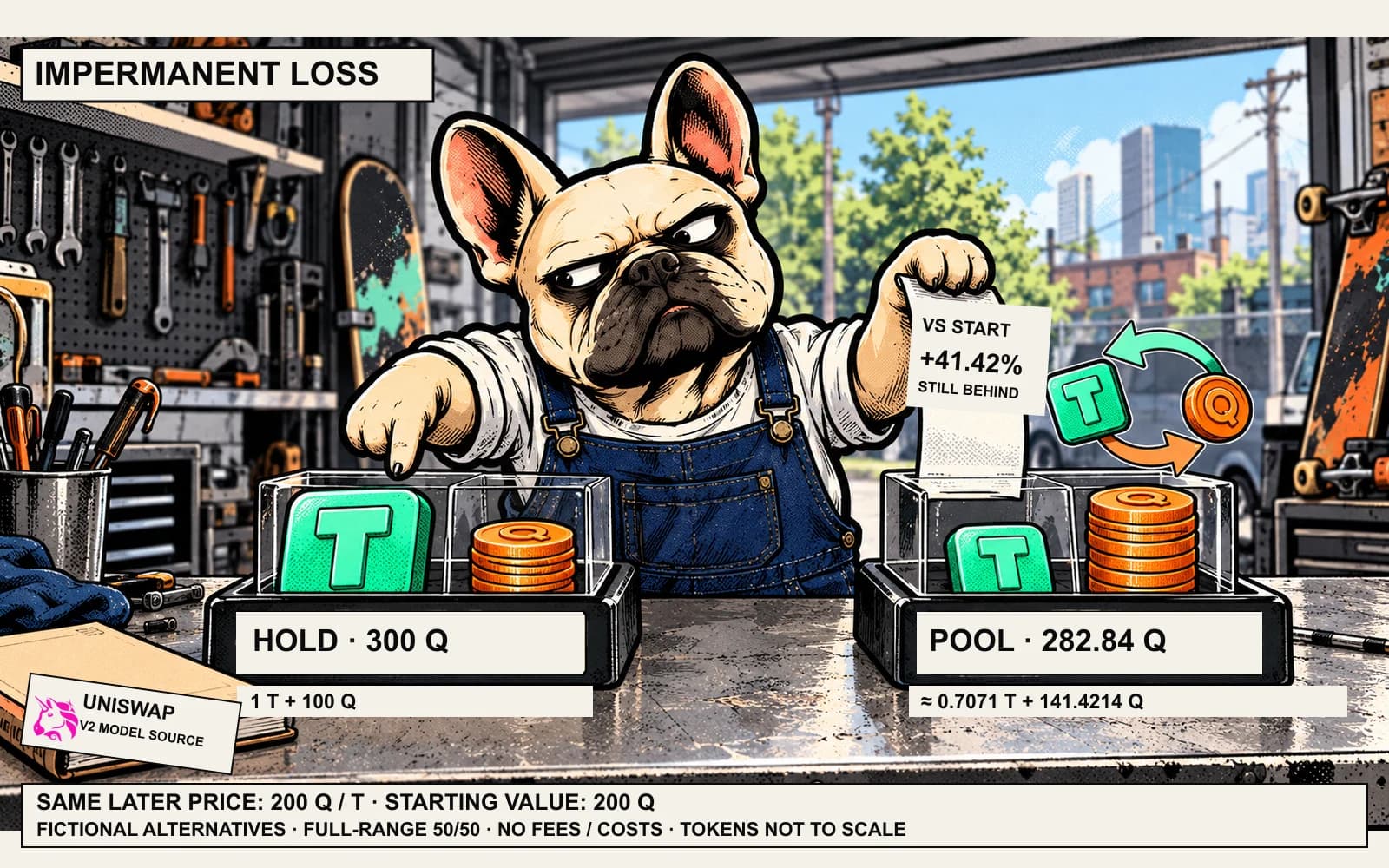
A pool position can rise from 200 to about 282.84 quote units and still have impermanent loss. The comparison is with the same starting tokens left outside the pool, which would be worth 300 quote units in this example.
For readers trying to understand an LP result, the missing detail is often the benchmark. We will calculate both outcomes at one assumed price, then separate that comparison from fees and losses of starting capital. None of the numbers below describes a live pool or a recommended trade.
What impermanent loss compares
The Uniswap protocol glossary defines impermanent loss in relation to simply holding the tokens. A liquidity provider, or LP, supplies assets that traders can exchange against. As swaps change the pool's balances, the LP's token exposure changes too.
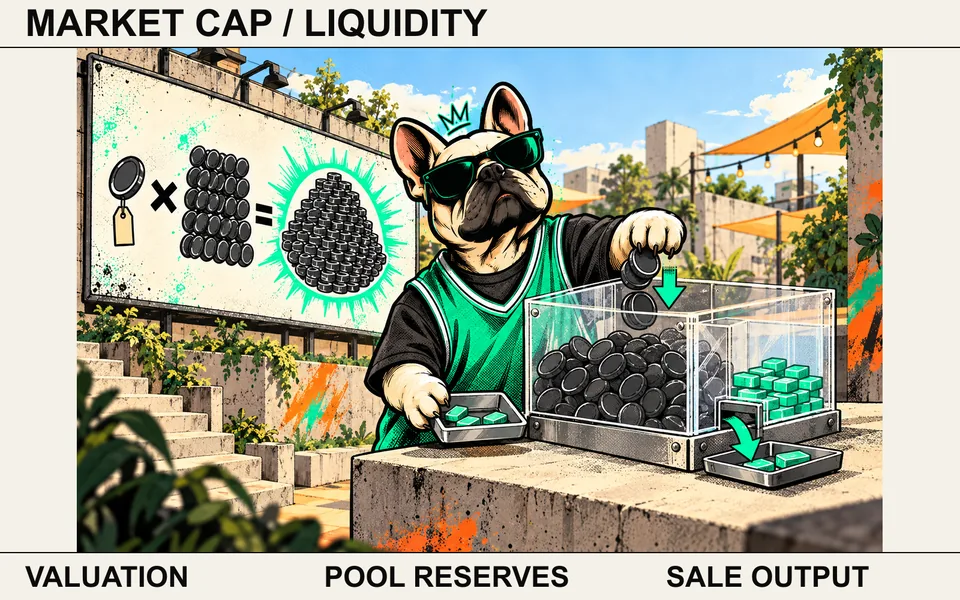
Holding preserves the original token quantities. Providing liquidity does not preserve that same basket. If you want the market-depth distinction first, read market cap versus liquidity; this article follows the provider's result rather than the amount a seller can execute.
Set up one explicitly fictional pool
Use two invented tokens, T and Q. Q is our unit of account, not a real stablecoin or a promise of dollar redemption. Initially, 1 T is valued at 100 Q.
The tiny teaching pool contains 1 T and 100 Q, so it starts with 200 Q of marked value. Its sole provider owns the whole position. Compare that with a separate hypothetical choice to keep 1 T and 100 Q without supplying liquidity. These are alternative uses of the same starting basket, not two deposits owned at once.
Assume a full-range, 50/50 constant-product model, no swap fees, no costs or rewards, no changes in liquidity supply, and ordinary token balances. Traders bring the pool's reserve ratio into line with the assumed outside price. We ignore rounding in the calculation until displaying the answer.
This is the simplified model documented in Uniswap's v2 returns explanation, not a calculation for every Uniswap version or every AMM. Its reserve relation is x × y = k, with the idealized marginal price in Q per T equal to y / x.
When the relative price doubles
Our starting product is 1 × 100 = 100. Now assume T is valued at 200 Q, while Q remains the unit of account. We need reserves whose product is 100 and whose ratio is 200:
x = √(100 / 200) ≈ 0.70710678 T
y = √(100 × 200) ≈ 141.42135624 Q
The pool contains less T and more Q. At the assumed new price, the position's marked value is:
0.70710678 × 200 + 141.42135624 ≈ 282.84271247 Q
The holding basket still contains 1 T and 100 Q:
1 × 200 + 100 = 300 Q
The shortfall is about 17.16 Q, or 5.72% of the 300 Q holding value. Relative to the 200 Q starting value, however, the pool position is up about 41.42%. Both statements are true because they use different denominators.
| Same assumed price: 200 Q per T | Pool position | Original tokens held |
|---|---|---|
| T quantity | About 0.70710678 T | 1 T |
| Q quantity | About 141.42135624 Q | 100 Q |
| Marked value | About 282.84 Q | 300 Q |
| Change from 200 Q starting value | About +41.42% | +50% |
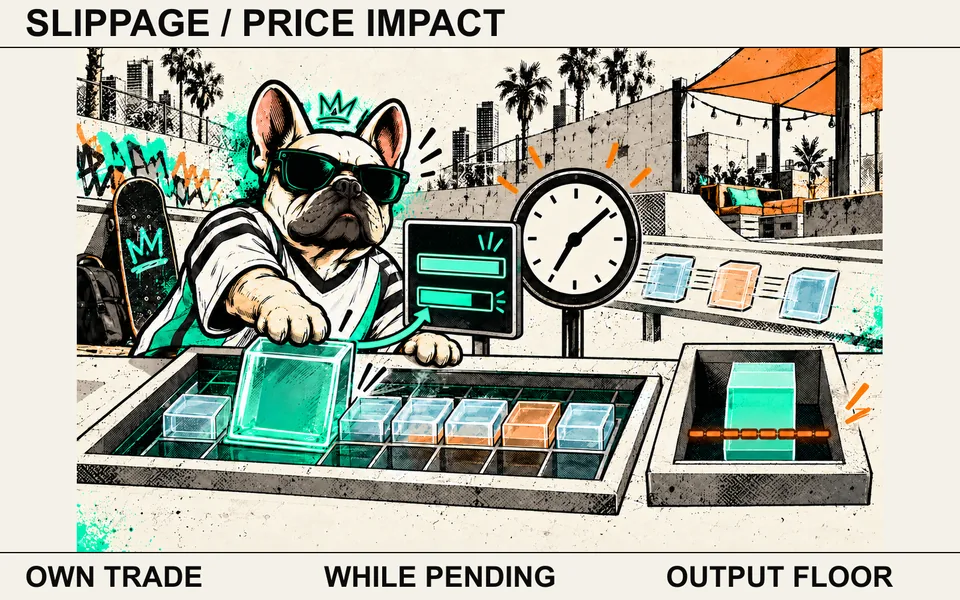
These are valuations at one assumed price. They do not promise an available exit at that price for the entire balance. Slippage and price impact explain that separate execution question.
When the relative price halves instead
Set the later price to 50 Q per T, keeping every other teaching assumption unchanged. The balances become about 1.41421356 T and 70.71067812 Q. Their combined marked value is about 141.42 Q. The unchanged holding basket is worth 150 Q.
The pool again trails holding by about 5.72%, but this time both choices are below the 200 Q starting value. A relative shortfall and a fall in capital are separate measurements; one percentage cannot stand in for both.
For this particular model, using r = later price / starting price, the signed relative result is 2 × √r / (1 + r) − 1. At r = 2 and r = 0.5, it is approximately −0.05719096, or −5.72%. This formula excludes the fees and costs left out of our assumptions.
Does "impermanent" mean it will recover?
No. In this idealized model, a return to the starting relative price makes the fee-free holding comparison equal again. Nothing in the formula promises that prices will return. It also says nothing about contract failures, token restrictions or whether a real position remains available to withdraw. Waiting is not a guarantee of recovery.
Where fees and concentrated ranges change the calculation
Fees belong in an actual LP result, but they are not a guaranteed compensation for the holding shortfall. Record the position's token amounts, accrued or collected fees, rewards and costs without counting the same item twice. A quoted annual rate alone cannot reproduce the outcome over your actual observation period.
Keep the assets' identities explicit too. Substituting a wrapped asset can introduce a different contract or redemption arrangement; our wrapped-token explainer covers that dependency. Do not replace missing fee or price data with an assumption of zero in a real result.
Uniswap's concentrated-liquidity documentation describes positions bounded by chosen price ranges. A position can become single-sided and stop earning swap fees while out of range. Its range therefore matters; the full-range formula above is not a universal calculator for it. The documented mechanics are not a recommendation to select a narrow range.
A comparison you can write down without connecting a wallet
For a worked example or a read-only review, keep these items together:
- The exact starting token quantities and valuation time.
- The same later prices and units for both the LP position and holding basket.
- The position's pool model, range and current quantities, rather than a generic "50/50" label.
- Fees, incentives and costs, with any unknown amounts left unresolved.
- Separate results versus holding and versus starting capital.
A price report also needs its source, scale and observation time. The DeFi oracle explainer explains why an available feed value is not automatically a trade quote. You do not need to connect a wallet or sign an approval to follow the arithmetic here.
Brokzi's take
Impermanent loss needs a stated comparison: the same starting tokens, valued at the same later prices. In our example the pool gains value while lagging holding. Before interpreting a percentage from a real position, establish its denominator, model and treatment of fees. If those are missing, the result is not yet reproducible.
Sources
Primary documentation checked 19 October 2026 (UTC). Uniswap's materials describe its own mechanisms. The calculations use fictional T/Q quantities with all assumptions stated; they are not a live return, a provider endorsement, investment advice or a deployed-contract audit. No wallet was connected and no liquidity was deposited.
- Uniswap protocol glossary: LP terminology and the holding benchmark.
- Uniswap v2: Understanding returns: the fee-free constant-product model and relative-price comparison.
- Uniswap: Concentrated liquidity: bounded positions, active liquidity and single-asset exposure outside a range.
See something wrong? Brokzi logs material changes. Prepare a correction note.