
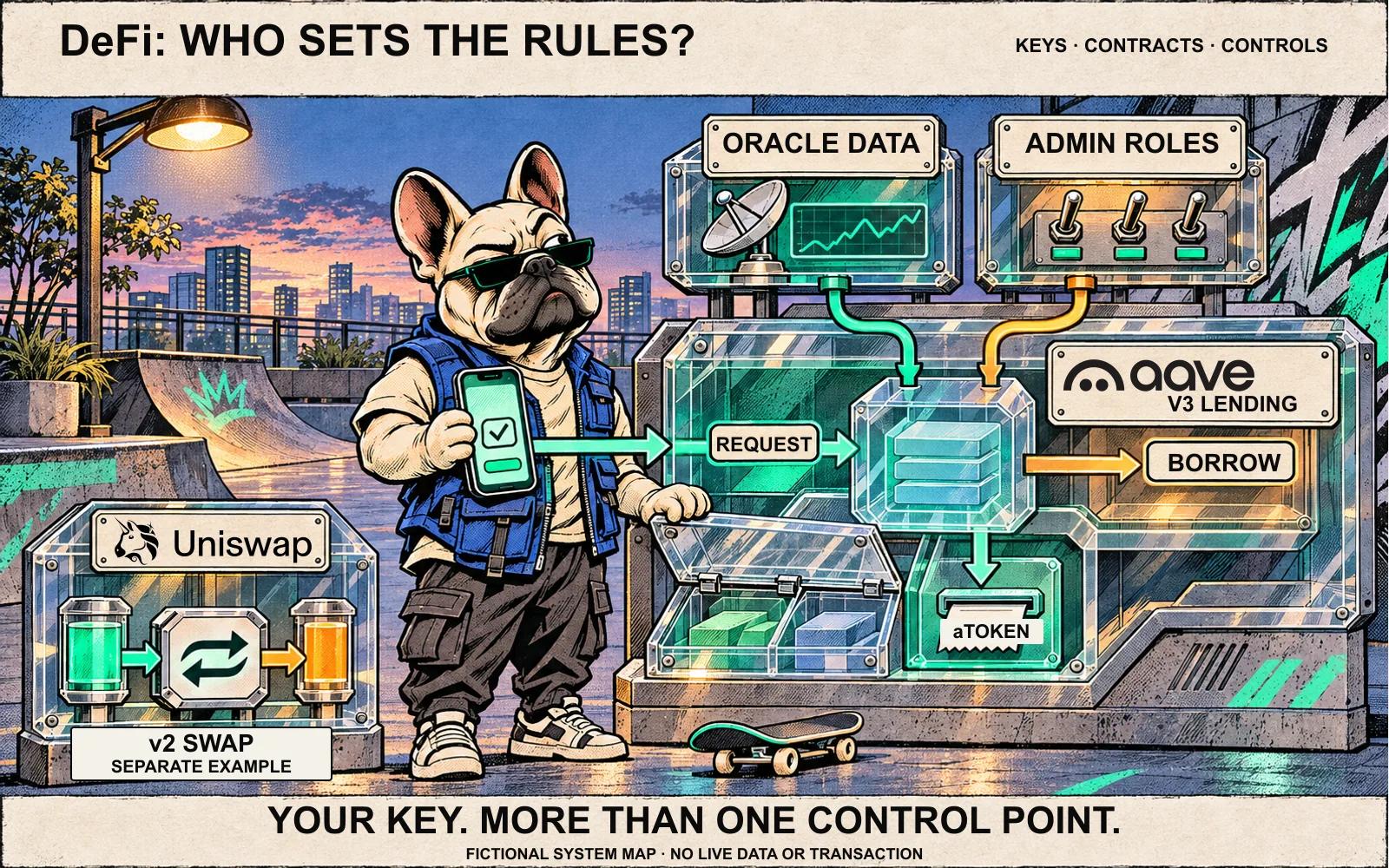
A DeFi app can put a wallet balance, an approval request, a lending position and a borrowing limit on one screen. Those are different things. Understanding what each one controls is more useful than treating “decentralized” as a single safety switch.
What is DeFi? It is the broad category of blockchain-based financial applications, including lending and swaps, described in Ethereum's DeFi overview. Here we follow the permissions, asset movements and rule-setting behind an action. The examples explain Aave V3 and Uniswap v2; they are not recommendations or claims about every DeFi system.
Start with four separate layers
| Layer | What it does | What it does not establish |
|---|---|---|
| Wallet and signing authority | Authorizes a transaction or a specific signed request | That the requested action is safe |
| Website or app | Displays information and prepares requests | That its display fully describes the contracts |
| Smart contracts | Apply code, hold or move assets, and record positions | That all inputs and configuration are beyond anyone's control |
| Dependencies and controls | Supply data, liquidity, token behavior and permissioned changes | That a withdrawal or other action will always succeed |
A position can involve all four. An approval is not a deposit, a claim is not immediately available cash, and a quote is not an executed swap. Keep these distinctions even when the interface makes them look like successive clicks in one task.
Aave V3: follow a supply action
Consider a plain ERC-20 supply through an Aave V3 market. This is a description of the documented route, not an instruction to deposit a particular asset or use a particular market.
Permission comes first. ERC-20 defines an allowance: how much a spender may transfer on an owner's behalf. For Aave V3's ordinary supply call, the Pool reference says the Pool needs sufficient allowance on the underlying token. The approval and the subsequent supply are different operations. Other routes can use permit signatures; do not assume every interface presents the same sequence.
Supply changes what you hold. Aave's supply documentation describes supplying assets and receiving aTokens. You retain the authority associated with your wallet, but the supplied underlying tokens are now committed to the protocol's contract system. The wallet can display a position rather than loose tokens waiting in the original account.
Collateral adds another role. A supplied asset may be used as collateral where that market's configuration permits it. Supplying and borrowing remain separate actions. Read the token-approval explanation for spender limits; this overview stops short of its full verification and revocation workflow.
Borrowing adds a dependency on valuations
Aave V3's Pool exposes borrowing and repayment functions alongside supply and withdrawal. Borrowing creates a debt position whose conditions must continue to be met; the fact that the original action succeeded does not freeze those conditions indefinitely.
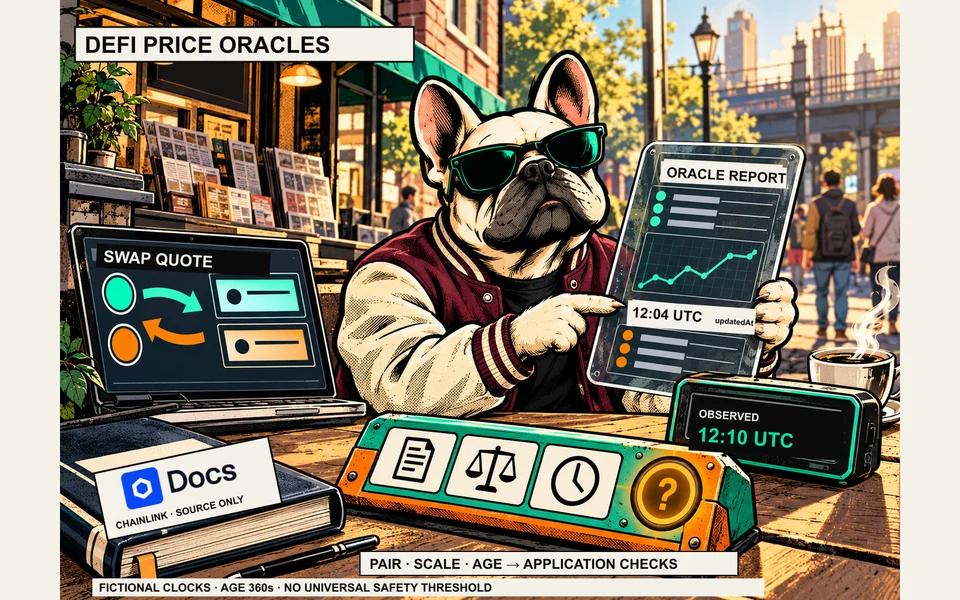
Aave's oracle reference describes AaveOracle returning asset prices from configured sources. Those prices are inputs to the system, not an offer to buy your collateral at that price. Their source and the way the application uses them belong in the dependency map.
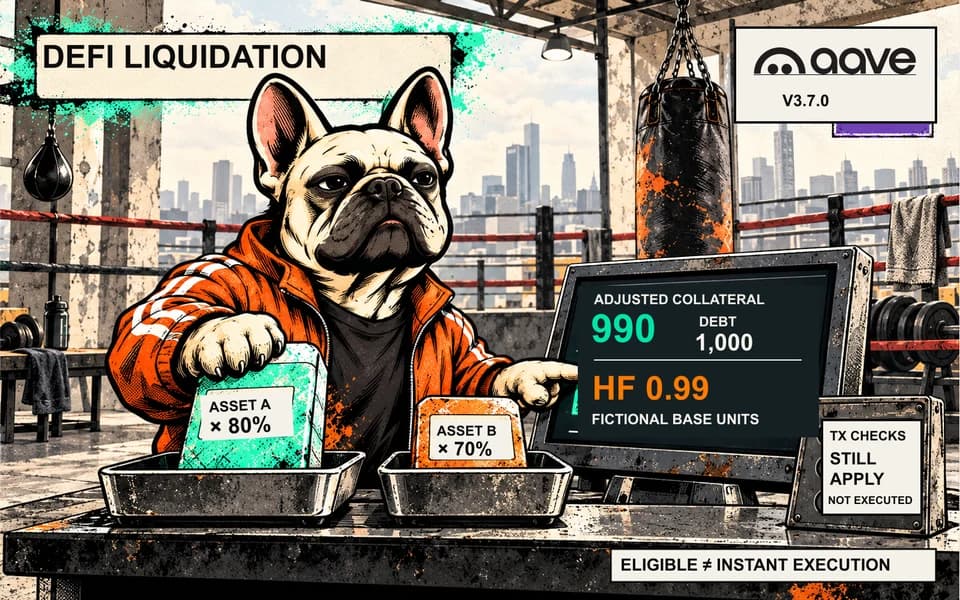
If collateral conditions deteriorate, liquidation can become possible under the relevant rules. The mechanism and arithmetic belong in our Aave V3 health-factor guide. Our price-oracle explainer separates reported data, freshness and executable trade quotes.
Holding the key does not guarantee an immediate exit
Aave's withdrawal documentation describes withdrawing previously supplied reserves. Its FAQ explains additional exit conditions. Available liquidity matters. A withdrawal that would leave a borrowing position insufficiently collateralized can also be constrained.
That is why “the position is visible in my wallet” and “this amount can leave the protocol now” are different statements. Reading a balance alone does not test the latter. A displayed position value is not a promised withdrawal time or a guaranteed amount in another currency.
The available-liquidity article works through a separate Compound III example. Its cash and utilization calculations should not be copied into Aave as though the implementations were identical.
Who can change or pause the rules?
Aave V3 documents explicit roles in its Access Control Manager. For example, risk administrators have reserve-configuration powers, and emergency or pool administrators have pause-related powers. Those permissions are not powers held by every user who can submit a supply transaction.
The Pool Configurator reference groups methods by permitted roles, including collateral configuration, supply and borrow caps, reserve freezing and pausing. “Frozen” and “paused” are different controls; one generic warning badge is not a complete explanation of their effects.
These pages describe the role model. They do not establish which addresses currently hold each role in a particular deployment, the latest configuration, or how quickly a change could be enacted. Those are deployment-specific checks. Our upgradeable-contract explainer covers another reason an address alone does not settle which rules will apply later.
Public participation and permissioned administration can coexist. Calling an application DeFi does not resolve that tension for you; identify the actual powers.
A swap pool solves a different problem
Uniswap v2's pool documentation describes contracts holding reserves of two ERC-20 tokens. A swap trades against those reserves. That is a different activity from taking a collateralized loan.
Providing liquidity is another distinct action: the provider receives pool tokens representing a share of pool liquidity. The LP-share explanation follows that accounting. This is explicitly the v2 model, not a description of every current Uniswap version or route.
Do not attach Aave's oracle and administrative structure to a Uniswap pool simply because both appear under DeFi. Identify the actual contract, version and dependencies for the action in front of you.
Read a DeFi screen as a system map
Before interpreting a position, locate the network and protocol version. Identify the contract receiving assets, the spender being authorized, the record or receipt you will hold, and the conditions for leaving. Then distinguish data sources and liquidity from the roles allowed to change configuration.
You can read documentation before connecting a wallet. This article makes no claim about a protocol's suitability in a particular country or account. The named systems illustrate mechanics, not a ranking, APR forecast or endorsement. No wallet connection, approval, supply, loan, swap or deployed-contract audit was performed.
The useful question is concrete: what am I authorizing, where will the assets be recorded, and which conditions can change afterward? That question connects the overview to the specialized articles without pretending one label answers everything.
Sources
See something wrong? Brokzi logs material changes. Prepare a correction note.