

Your withdrawal receipt shows one fee. The blockchain explorer shows another. Before deciding that either number is wrong, check whether they refer to the same thing: one customer's charge or the whole transaction that delivered the funds.
For readers comparing an exchange withdrawal network fee, this explainer separates the platform's terms from the network record. Coinbase and Binance provide named examples of published fee disclosures. No account was opened, quote obtained or withdrawal submitted for this article.
Three fields that should not share one label
A withdrawal charge answers how much a service charges its customer for that request. A minimum answers whether the service accepts a request of that size. A network transaction fee answers a different question about the transaction executed on the selected blockchain.
| Field | What to establish | What it cannot establish alone |
|---|---|---|
| Customer withdrawal charge | Amount, unit and whether it is deducted or added in that preview | The final fee of a specific blockchain transaction |
| Minimum withdrawal | Current threshold for that asset, network and product | That the threshold itself is a fee |
| Network transaction fee | The actual transaction and the network's fee accounting | One customer's charge or an exchange's complete revenue |
Even matching units do not make the fields interchangeable. A line in BTC and a transaction fee in BTC can concern different scopes. If one line is in a token and another in ETH, a direct subtraction is not meaningful without a stated conversion and valuation time.
Coinbase describes an estimate and a possible batch difference
Coinbase's pricing disclosure says its charge for an external crypto send uses an estimate for a standalone send. Its eventual network payment can differ because of batching or changing congestion. It also says customers' combined estimated fees in a batch can exceed the final network fee.
That is the disclosed mechanism, not our measurement of a particular withdrawal. The page warns that its fees do not apply in every region and can change. It also lists separate processing charges for some routes or assets; a network-fee line is not proof that no other charge applies.
Binance separates the fee from the minimum
Binance's withdrawal-fee FAQ describes an estimated network-based charge and directs readers to the withdrawal page for the current amount. It separately identifies a minimum and says both depend on the chosen network and can change.
The FAQ carries a March 2, 2021 publication date; checking it today does not turn it into a new tariff announcement. We use it for that distinction, not as a numeric rate sheet or evidence of availability for every country, entity or account. Its network warning also matters: a cheaper listed route does not establish compatibility with the destination.
A fictional receipt comparison
The following arithmetic is not a live quote, a reconstruction of either exchange or evidence about their margins. It is an invented bookkeeping example on Bitcoin's onchain network.
Assume a hypothetical service handles two customers in one transaction. It deducts 600 sats from each customer's requested amount as a withdrawal charge. Both requests are accepted under its fictional service rules. There are no other customer charges in this example.
| Fictional record | Customer A | Customer B | Combined |
|---|---|---|---|
| Amount before the stated deduction | 50,000 sats | 70,000 sats | 120,000 sats |
| Customer withdrawal charge | 600 sats | 600 sats | 1,200 sats |
| Amount delivered | 49,400 sats | 69,400 sats | 118,800 sats |
Separately assume the entire batch transaction pays 900 sats onchain. The customer charges total 1,200 sats; their difference from the whole transaction fee is 300 sats. That difference does not establish the hypothetical business's net profit: other costs and accounting are absent from the example.
Nor does 900 divided by two establish that either customer was contractually charged 450 sats. Equal allocation is an extra assumption. There can be several ways to allocate a shared cost; a transaction record does not supply the service's billing policy.
Bitcoin Core's v31.1 transaction model supports multiple inputs and outputs in one transaction. That structure helps explain why one transaction ID need not mean one withdrawal. Our Bitcoin virtual-size explainer owns the separate size-and-fee calculation. The example here derives no actual batch size, fee rate or exchange wallet ownership.
The fee unit also depends on the network
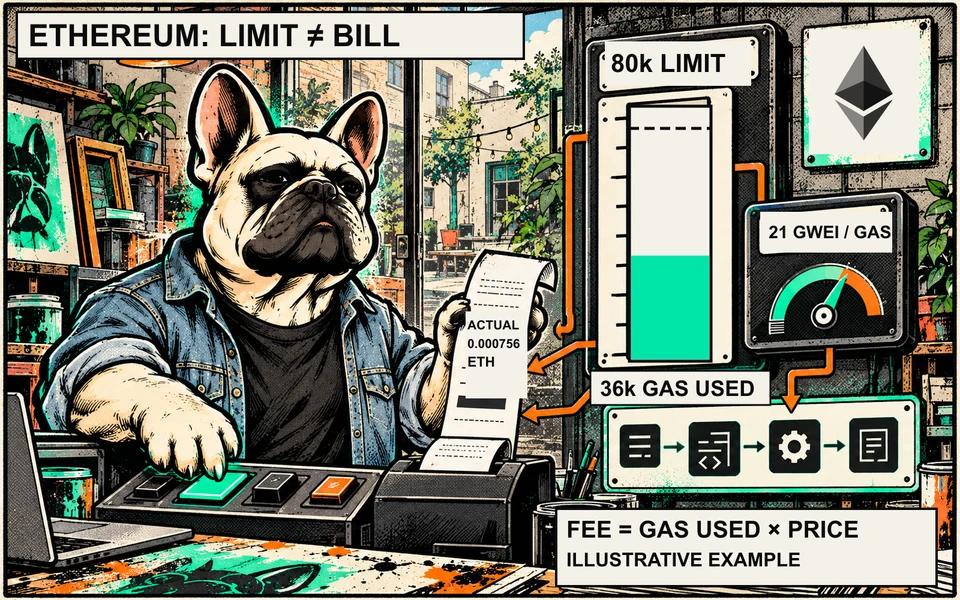
Ethereum's gas documentation describes execution fees in ETH, calculated from gas consumed and the effective price per gas. Its base fee is burned; the priority fee goes to the validator. It would therefore be inaccurate to describe every Ethereum fee as money handed in full to a miner or an exchange.
An exchange's charge for withdrawing an ERC-20 token can use a different unit from the ETH spent executing a transaction. That does not identify the conversion method, markup or exact amount. Those need the applicable disclosure and receipt. Our gas-limit versus gas-price guide covers the network calculation without treating an exchange's customer balance as a self-custodial gas balance.
Read the route before comparing the price
Keep the product, asset and selected network attached to every number. Then record the fee unit, minimum, amount entered and amount the destination is expected to receive. Distinguish an estimate or preview from a completed receipt and a final network record.
For tokens, the symbol, contract and network identify the route more precisely than a familiar ticker. A fee comparison cannot establish that the recipient supports that route. Our wrong-network guide explains that separate compatibility problem.
A transaction ID is useful for reconciling execution, but neither a submitted request nor a displayed fee establishes final delivery or receiving-account credit. Bitcoin confirmations and exchange credit cover that distinction. Avoid treating a platform's pending withdrawal state as a confirmed network payment.
The practical comparison is the customer's documented charge beside the relevant network transaction, with their different scopes visible. A fee label alone cannot make them the same record.
Sources
Primary documents checked October 28, 2026, Asia/Tbilisi, after an interrupted October 27 preparation. Coinbase's regional warning and Binance's historical FAQ date remain relevant. The documents are not personalized quotes or a universal fee schedule. Bitcoin code is pinned to v31.1; the Ethereum discussion concerns its L1 execution fee, not every L2 or bridge cost. All example amounts and the comic are fictional. No account, private receipt, exchange wallet, withdrawal, transfer, node or transaction was tested.
- Coinbase: pricing and fees disclosures for crypto.
- Binance: crypto withdrawal fees and minimums, published March 2, 2021, read as general guidance rather than a current numeric quote.
- Ethereum: gas and fees.
- Bitcoin Core v31.1: transaction inputs and outputs.
See something wrong? Brokzi logs material changes. Prepare a correction note.