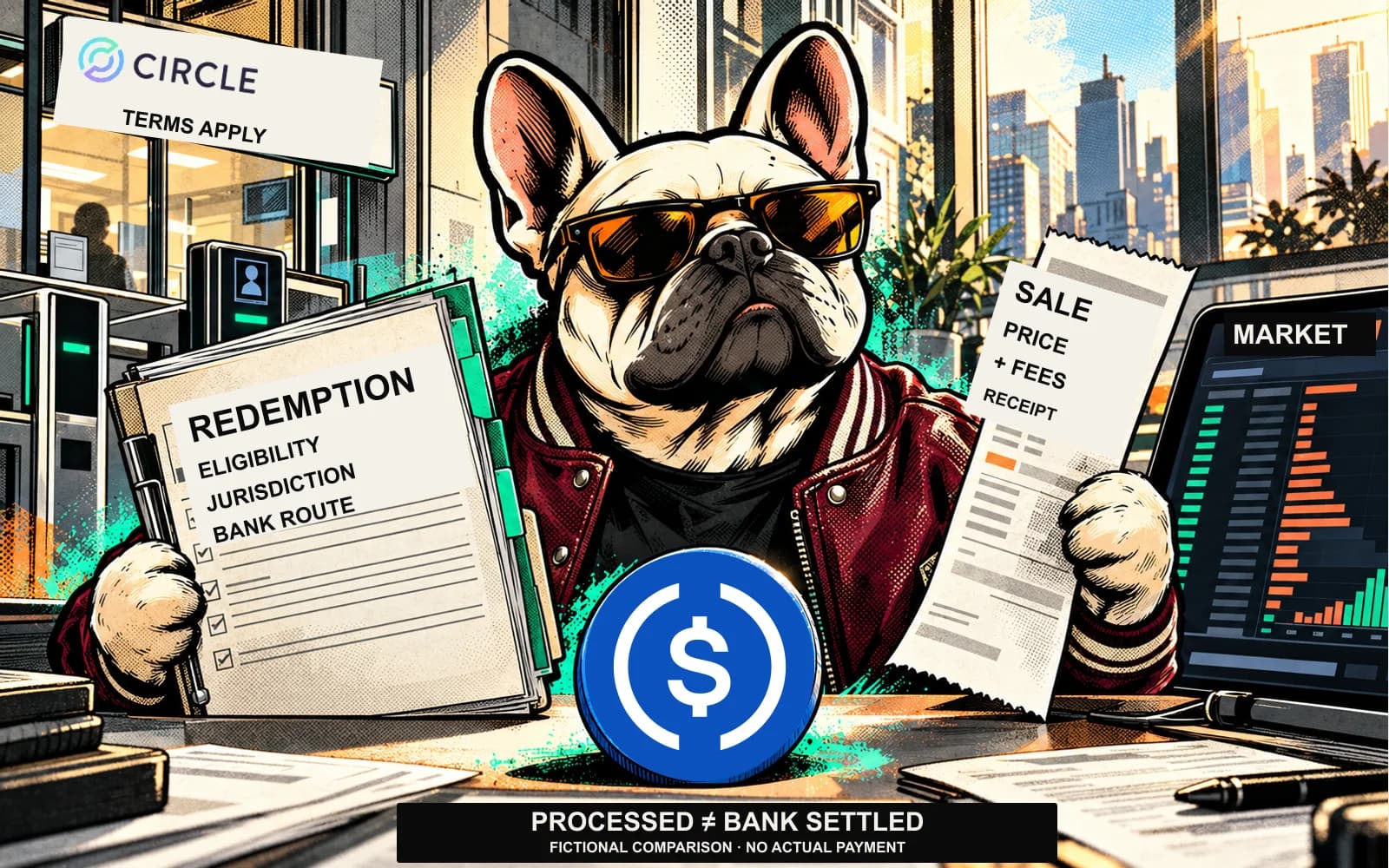
The wallet says dollars. The exit still needs a route.
Stablecoin redemption and a secondary-market sale can end with a lower token balance, but they answer different questions: will the issuer redeem under its terms, or will a market buyer pay this price? Neither a token balance nor a sell button establishes what reaches a bank account.
This explainer uses Circle-issued USDC as a named example. It compares documented routes, not the status of a particular customer. Every trading price and trading fee in the worked example is invented.
Two exits, two different transactions
Circle's USDC Terms distinguish issuer redemption at one dollar per USDC, subject to terms and applicable fees, from third-party market prices. They do not guarantee a dollar price on an exchange.
| Question | Issuer redemption | Secondary-market sale |
|---|---|---|
| What is being requested? | Redemption under the issuer's applicable conditions | A trade with a buyer at an execution price |
| Which price matters? | The issuer's redemption terms and applicable charges | The actual fill price and trading charges |
| Does a completed step mean bank cash? | Processing and bank settlement remain distinct | Sale proceeds can still be a platform balance or another asset |
A completed trade is not proof that the issuer redeemed those tokens for the seller. Equally, an issuer's redemption policy is not a standing bid available on every trading venue. Our stablecoin overview explains how these separate mechanisms can affect a peg.
Outside the EEA, holding USDC does not create a Mint account
The USDC Terms, updated October 15, 2026, apply outside the EEA. They separate Circle Mint account holders from other USDC holders and condition direct redemption on an eligible account in good standing.
Read that alongside the Circle Mint User Agreement, also updated October 15. Its eligibility section says Mint is available to institutions in supported jurisdictions, with verification and possible additional requirements. It is not an invitation for every individual wallet holder to open a retail cash-out account.
The agreement also requires a linked, verified bank account in the relevant customer's name for the described mint/redemption route. Local addenda and the contracting entity still matter. A blockchain address is not banking instructions.
Circle's country-support page separates fiat connectivity from wallet-only support. A place appearing on a country list is not proof of account approval or access to every service. Do not turn a geographic listing into a personal eligibility decision.
The EEA has a separate retail-redemption policy
Circle France's MiCA Redemption Policy, updated September 15, 2026, describes a separate route for EEA holders. It states a right to redemption at par subject to the policy's conditions and distinguishes existing customers, non-retail holders and retail holders.
For retail holders, it describes a dedicated request process, eligibility assessment, identity and transaction checks, and an EEA bank-account IBAN. For USDC, the bank account must accept USD; third-party banking or conversion charges may apply.
This does not mean that every person worldwide has the same process. Nor should an EEA retail holder's stated route be erased by applying the outside-EEA institutional Mint rule to them.
The policy includes restriction and stress-event provisions that can affect processing. A published right and its operational conditions need to be read together. This article does not determine an individual's legal rights, eligibility or outcome and does not walk through a transfer or application.
Identify the token and the receiving route separately
Circle's contract registry identifies USDC across named networks and separates mainnet from testnet. For example, its Ethereum mainnet entry is 0xA0b86991c6218b36c1d19D4a2e9Eb0cE3606eB48.
That identifies the registry's token entry. It does not, by itself, establish that a particular account accepts deposits over that network. A ticker, wrapper or test token is not interchangeable with the issuer's identified native asset. Use the token-and-network guide for that distinction; this page supplies no deposit address or transfer instruction.
A redemption fee and a settlement clock are different costs
The current Circle Mint redemption structure describes Standard redemptions without a Circle redemption fee and Express redemptions with a five-basis-point charge on gross redemptions before applicable credits. The change starts on or after October 19, 2026; existing customers transition at the next billing period. Separate written agreements can control.
The page describes Standard processing within two business days and Express processing near-instantly, both followed by bank settlement time. Its clock begins with acceptance of a complete request. Compliance review and banking or payment-rail availability can extend processing.
These are Mint service descriptions, not a universal retail fee quote or a cash-arrival guarantee. Credits are conditional; do not assume one. Bank, conversion and network costs are separate questions. A zero Circle redemption fee does not establish a zero-cost exit.
A fictional sale: count the dollars after the trade
Imagine a sale of 10,000 USDC, fully filled at an invented $0.998 per USDC, with an invented 0.10% trading fee charged on dollar proceeds. Assume that the quoted fill covers the whole quantity, without additional price movement.
| Fictional sale calculation | Amount |
|---|---|
| Gross dollar proceeds: 10,000 × $0.998 | $9,980.00 |
| Trading fee: $9,980 × 0.001 | $9.98 |
| Dollar balance after this trading fee | $9,970.02 |
The difference from $10,000 is $29.98: a $20.00 price difference plus the $9.98 trading fee. It is not all a fee, and it is not a measured depeg. No exchange, order book or live quote was inspected for these invented numbers.
The resulting $9,970.02 is a hypothetical post-trade balance, not a bank receipt. Withdrawal, conversion, network and bank charges are excluded. So are taxes and any further execution changes. There is no claim that this exit is available or preferable.
For comparison of units only, five basis points equals 0.05%, so applying that rate to $10,000 gives $5 before any credit. That arithmetic does not establish a customer's applicable redemption fee, deduction timing or bank proceeds.
Keep a record of the route, not just the peg
Before comparing two displayed amounts, identify what each one actually represents:
- The exact issuer, token and network.
- The holder and jurisdiction covered by the relevant terms.
- Whether the proposed action is issuer redemption, a trade or a later withdrawal.
- The price, fee base, currency and excluded charges.
- The stage reached: accepted request, processed redemption, executed trade or credited bank payment.
Our liquidity explainer covers why a valuation does not establish exit cash. The USDC freeze explainer addresses a different layer: token transfer controls. Neither substitutes for the terms of a particular redemption or sale.
Sources
Primary documents and rendered Help Center pages checked October 28, 2026, Asia/Tbilisi. These are issuer statements, not our reserve audit, eligibility decision or legal opinion. No account was opened, wallet connected, live balance queried, token sent, trade placed or redemption tested. The artwork is a fictional comparison. Fees, support and terms can change; this is education, not a recommendation to redeem or sell.
- Circle: USDC Terms, outside-EEA scope.
- Circle: Mint User Agreement, eligibility and linked bank accounts.
- Circle France: MiCA Redemption Policy.
- Circle Help Center: USDC/EURC redemption structure.
- Circle Help Center: Mint supported countries and regions.
- Circle Docs: mainnet and testnet USDC contract registry.
See something wrong? Brokzi logs material changes. Prepare a correction note.